Confidence & Courage
How to Teach Kids Patience and Delayed Gratification: 8 Simple Ways (Ages 4–8)
By Audrey Bell-Kearney ·
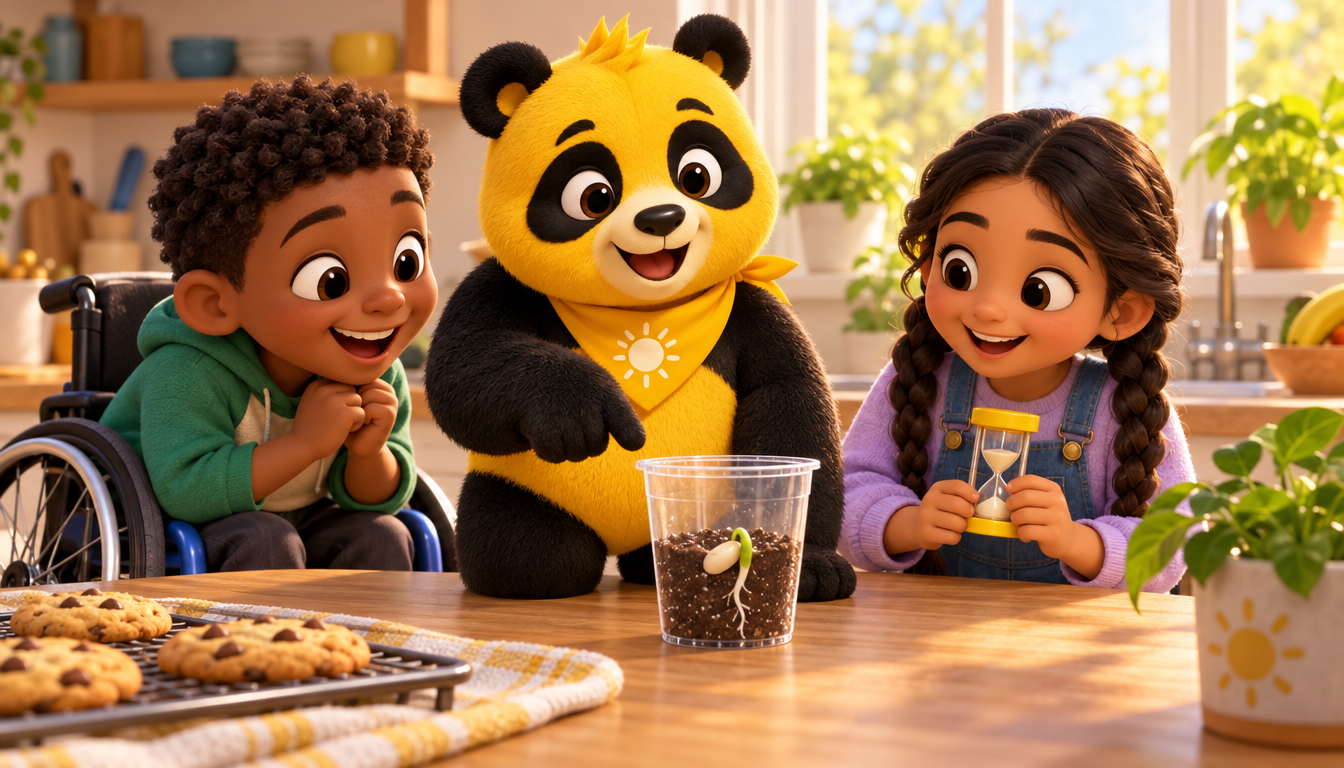
Quick takeaway: Waiting is a skill kids can practice. Here are 8 simple ways to teach patience and delayed gratification, with what to say, easy games and a Sunny seed activity.
To teach kids patience and delayed gratification, treat waiting like any other skill: practice it in small, playful doses. Make time visible with a timer, give your child something to do while they wait, and always keep your "later" promises. Then stretch the wait a little at a time.
Waiting is hard for young children because the part of the brain that helps them stop, plan and hold back is still growing. A four-year-old who melts down at "not yet" is not being spoiled. They are being four.
The good news is that self-control grows with practice. The Harvard Center on the Developing Child points out that simple games, like freeze dance, ask children to stop an action on cue. That stopping is exactly the muscle kids use when they wait for a turn, a snack or a birthday.
Below are eight ways to build patience at home or in the classroom, with what to say and how to start today.
What Patience Looks Like at Ages 4 to 8
Every child is different, so use this as a loose guide, not a test.
- Around age 4: Waits best when the wait is short and something is happening. Needs lots of help, like a song or a job to do.
- Around age 5 or 6: Can start using a timer or a picture chart. Begins to understand "after lunch" or "on Saturday."
- Around age 7 or 8: Can work toward a goal over days or weeks, like saving for a toy, with reminders and encouragement.
If your child is on the younger end of this list, that's okay. Start where they are.
1. Make Time Something Kids Can See
"Five more minutes" means very little to a young child. They can't feel time passing yet. Show it to them instead.
How to do it today (1 minute, a sand timer or kitchen timer):
- Set a timer they can watch, like a sand timer or a visual countdown on a phone.
- Say, "When the sand runs out, it's your turn on the tablet."
- Let your child be the one who flips it or presses start.
- When it ends, keep your word right away.
For longer waits, draw a simple picture chart: "Breakfast, then park, then lunch, then Grandma's house." Your child can cross off each step.
2. Give Waiting a Job
Waiting with nothing to do is the hardest kind. Kids who wait well usually find something else to think about.
In the famous "marshmallow" studies, researchers noticed that the children who waited longest were good at distracting themselves. You can teach that on purpose.
How to do it today (what to say):
- "Let's count backward from 20 while we wait."
- "Can you find five blue things in this waiting room?"
- "Let's hum the whole ABC song before the cookies are ready."
- "Draw me a picture of what you'll build at the park."
Over time, ask, "What could you do while you wait?" Let your child come up with their own ideas.
3. Play Stop-and-Go Games
Games are the easiest way to practice self-control, because kids don't even notice they're practicing.
How to do it today (5 to 10 minutes, music):
- Freeze dance: Play music. When it stops, everyone freezes. Make it harder by calling out a shape: "Freeze like a tree!"
- Red light, green light: One person calls the colors. Everyone else moves only on green.
- Slow-motion race: The *slowest* person to reach the couch wins.
These games are silly and loud, and that's the point. Your child is learning to stop when every part of them wants to go.
4. Keep Your "Later" Promises
This one is for grown-ups. Children wait more easily when they trust the wait will pay off. If "later" often turns into "never," waiting stops making sense.
Researchers who revisited the marshmallow test found that kids gave up faster when an adult had broken an earlier promise to them. Trust comes first.
How to do it today:
- Only say "later" when you mean it.
- Make it specific: "After dinner, we'll read two books."
- If plans change, say so honestly: "I said the park, and now it's raining. Let's pick a new time together."
Every kept promise is a deposit in your child's patience bank.
5. Start Small and Stretch the Wait
Nobody runs a marathon on day one. Patience works the same way.
How to do it today (a few seconds to a few minutes):
- Pick an everyday moment: snack time, a turn on the swing, a new toy out of the box.
- Start with a wait your child can handle, even if it's only 10 seconds.
- Celebrate it: "You waited the whole time! Your patience is growing."
- Next time, add a little more.
When Amara wanted her apple slices *right now*, her mom started with "Count to ten with me." A month later, Amara could wait while her mom finished cutting the whole apple.
6. Talk Through Your Own Waiting
Kids learn more from watching us than from listening to us. Let them hear how you handle waiting.
How to do it today (while you're doing something real):
- In a long line: "I really want to be done. I'm going to take a slow breath and look around."
- At home: "I want a cookie, but I'll wait until after dinner so I enjoy it more."
- In traffic: "This is slow. Let's play I Spy until it moves."
Keep it calm and short. You're showing that waiting can feel uncomfortable *and* be handled.
7. Save Up for Something Small
Saving is delayed gratification your child can hold in their hands. It also builds early money skills.
How to do it today (15 minutes to set up, a jar and a paper chart):
- Help your child pick a small goal, like a ball, a book or a special treat.
- Draw a picture of it and tape it to a clear jar.
- Make a chart with a few boxes. Your child colors one in each time a coin goes in.
- Keep the goal close, a few days for a four-year-old, a few weeks for an eight-year-old.
When the jar is full, go buy it together. Then ask, "How does it feel to get something you waited for?"
8. Plant a Wait-and-See Seed
This is a Sunny's Clubhouse favorite. Nothing teaches patience like a seed that takes its time.
How to do it today (10 minutes, a clear cup, a paper towel and a dry bean):
- Dampen a paper towel and tuck it inside a clear cup.
- Slide a bean between the towel and the side of the cup so you can see it.
- Put it near a window and keep the towel damp.
- Each morning, your child checks the bean and draws what they see.
It may take several days before anything happens. That waiting is the whole lesson. When the first root peeks out, your child will feel it was worth it.
Sunny Says: "Good things grow when I wait!" Teach your child to say it whenever waiting feels long. Say it with them, too.
When Waiting Ends in Tears
Sometimes the wait will be too long, and your child will cry or stomp. That's normal. Stay calm, name the feeling ("Waiting is so hard. You really want it now."), and help them breathe or take a break. Talk about it later, when everyone feels better.
If waiting meltdowns are frequent or intense, or self-control is hard in most parts of the day, talk with your pediatrician.
This Week's Shine Challenge
Choose one "wait moment" each day this week, like waiting for dinner or a turn on the slide. Before it starts, ask your child, "What will you do while you wait?" Afterward, cheer together: "Good things grow when I wait!"
Questions Parents and Teachers Ask About Teaching Patience
What age can a child learn delayed gratification?
Children start practicing small waits as toddlers, and the skill keeps growing through the early school years and beyond. A four-year-old may manage a minute or two with help. An eight-year-old can often save toward a goal for weeks.
Is it normal for my 5-year-old to have no patience?
Yes. Self-control is still developing at five, so waiting is hard for most kids this age. Short, regular practice, visual timers and lots of encouragement help more than lectures do.
Should I reward my child for waiting?
A big reward isn't needed. The thing they waited for is the reward, and your specific praise adds to it: "You waited the whole time the sand ran down." Keep the promise you made, and that builds trust for next time.
How do I teach patience in the classroom?
Use visual timers and picture schedules so children can see what comes next. Build stop-and-go games like freeze dance into transitions. Give children a waiting job, like a quiet hand signal or a song, while they line up or wait for a turn.
Does screen time make kids less patient?
Fast, instant entertainment can make slower moments feel extra boring. You don't need to ban screens. Do make sure your child has plenty of everyday chances to wait, play and work toward something slowly.
Get the Free Power of Kindness Pack
Want more simple ways to help your child grow patient, kind and confident? Our free Power of Kindness Pack has easy activities and Sunny's encouraging words for home or class.
Further Reading
More on Confidence & Courage
Confidence & Courage
Perfectionism in 6-Year-Olds: 8 Gentle Ways to Help (and What to Say)
Crumpled drawings, tears over one wrong letter? Here's what perfectionism in 6-year-olds looks like, and 8 gentle ways to help your child make peace with mistakes.
Confidence & Courage
How to Help a Child Who Gives Up Easily: 8 Gentle Ways to Build Stick-With-It Skills
Kids who quit fast are usually tired, scared of mistakes or facing a task that feels too big. Here are 8 simple ways to build persistence, with exactly what to say.
Confidence & Courage
9 Books About Making Mistakes for Kindergarten (With Questions to Ask)
Nine picture books that help kindergartners see mistakes as part of learning, each with one question to ask and a quick activity to try today.
Get The Sunbeam Signal
Simple ideas, playful activities, and a little Sunny inspiration for helping children shine.
For adults only. This optional newsletter is separate from free Power Pack access. Unsubscribe anytime.