Big Feelings
8 Animal Breathing Exercises for Kids (Panda Breaths, Bunny Sniffs & More)
By Audrey Bell-Kearney · · Updated
Quick takeaway: Eight playful animal breathing exercises that help kids ages 4–8 calm down, with simple steps, what to say, and which breath fits which feeling.
Animal breathing exercises are simple calm-down breaths that borrow a picture from an animal, like a buzzing bee or a sniffing bunny. The picture gives young children something fun to copy, so they slow their breathing without a lecture. Practice them when your child is calm, and they become a tool your child can reach for when feelings get big.
"Take a deep breath" is hard advice for a five-year-old. What does deep mean? How long is a breath? An animal answers those questions. "Hiss like a snake until your air runs out" is something a child can see, hear and do.
PBS KIDS for Parents explains why this helps. When we're upset, our breathing gets quick and shallow. Slow, deep breaths send a message back to the brain that it's okay to settle down. Animal breaths are simply a playful way to get there.
Start When Everyone Is Calm
The biggest mistake is teaching a new breath in the middle of a meltdown. A child who is screaming can't learn anything new. Instead, practice at bedtime, after school or during morning meeting, when nobody is upset.
Try one animal a day for a week. Do it together, and make it silly. Once your child knows a few breaths by heart, you can offer them in hard moments with just a word: "Want to do Snake?"
Two quick safety notes. Skip long breath-holding with little ones, and keep fast breaths short. If your child feels dizzy, stop and breathe normally together.
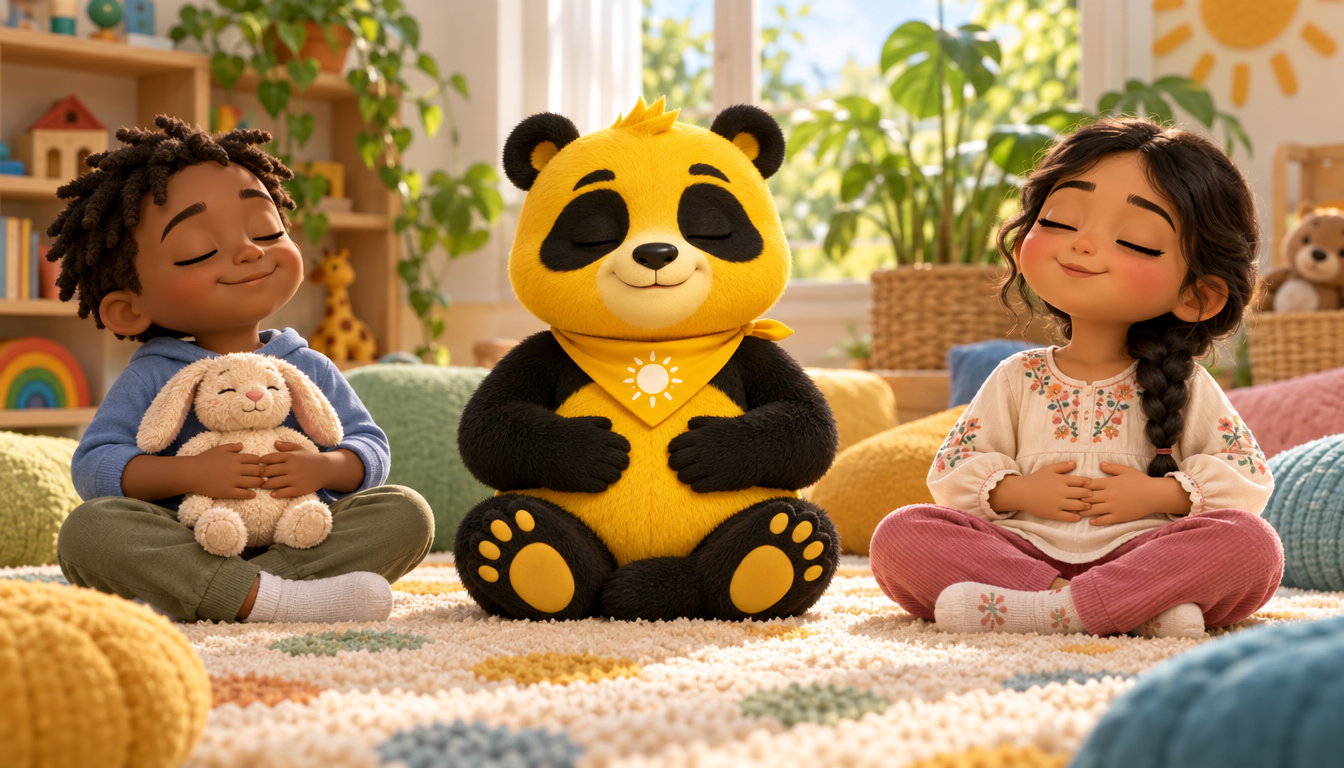
1. Sunny's Panda Belly Breath
Best for: Winding down, bedtime, the start of a calm-down. Time: 1 minute. Materials: None (a stuffed animal is a fun bonus).
Sunny the Panda loves a slow, sleepy breath after a big day in Sunny's Clubhouse. Sit like a panda munching bamboo, or lie on your back. Put both hands on your round panda tummy.
Breathe in slowly through your nose and feel your tummy grow big. Breathe out slowly through your mouth and feel it get small. Do five breaths. For extra fun, rest a stuffed animal on your child's belly and give it a gentle ride up and down.
What to say: "Let's fill our panda tummies like a balloon… and let the air out slowly."
Sunny Says: "Big breath in, slow breath out. I've got this!"
2. Bunny Sniffs
Best for: Feeling stuck, shy or teary. Time: 30 seconds. Materials: None.
Sit up tall on your knees like a bunny. Wiggle your nose. Take three quick little sniffs in through your nose, like you smell a carrot. Then let out one long, slow breath through your nose or mouth.
Do it three times, no more. The long breath out is the calming part, so stretch it a little longer each time.
What to say: "Sniff, sniff, sniff… and slowww out. Did you find the carrot?"
3. Bumblebee Hum
Best for: Too much noise, a busy classroom, a whiny moment. Time: 1 minute. Materials: None.
Sit tall and relax your shoulders. Close your eyes if that feels okay. Breathe in through your nose. Then close your lips and hum like a bee for as long as your breath lasts.
Kids love feeling the buzz in their lips and cheeks. For a group, see who can make the longest, quietest buzz.
What to say: "Let's be bees. Breathe in… and bzzzzzz."
4. Snake Hiss
Best for: Frustration, wiggles, waiting. Time: 1 minute. Materials: None.
Breathe in slowly through your nose. Then breathe out through your teeth with a long "ssssss," like a snake sliding through the grass. Try to make the hiss last as long as you can.
A long breath out is a gentle way to slow the whole body down. The sound also gives your child something to focus on besides the problem.
What to say: "How long can your snake slide? Ready… sssssss."
5. Elephant Trunk Breath
Best for: Kids who need to move, restless afternoons. Time: 1–2 minutes. Materials: Room to stand.
Stand with your feet wide apart. Clasp your hands together and let your arms hang down like a trunk. Breathe in through your nose as you swing your trunk up high over your head. Breathe out through your mouth as you swing it slowly back down.
Repeat four or five times. Some children add a gentle "pfff" sound on the way down, like an elephant spraying water.
What to say: "Scoop up the water… and spray it out slowly."
6. Starfish Hand Breath
Best for: Quiet calming anywhere: the car, a waiting room, a desk. Time: 1 minute. Materials: Your hand.
Spread one hand wide like a starfish. Use the pointer finger of your other hand to slowly trace around each finger. Breathe in as you trace up a finger. Breathe out as you trace down.
Five fingers make five calm breaths. This one is great because no one around you has to know you're doing it.
What to say: "Up the starfish arm, breathe in… down the other side, breathe out."
7. Turtle Shell Breath
Best for: Feeling overwhelmed, needing a little space. Time: 1–2 minutes. Materials: None (a blanket is a cozy extra).
Kneel and curl up small, with your forehead near the floor, like a turtle tucked in its shell. Take three slow breaths inside your "shell." When you feel ready, slowly poke your head out and stretch tall.
This breath gives children permission to take a short break. It pairs well with a calm-down corner.
What to say: "Take some time in your shell. Come out when you're ready."
8. Lion Roar
Best for: Mad feelings that need to come out. Time: 30 seconds. Materials: None.
Sit on your knees with your hands on your knees like lion paws. Take a big breath in through your nose. Then open your mouth wide, stick out your tongue and breathe out with a loud "haaa" roar.
Do two or three roars, then follow with a slower breath, like the Panda Belly Breath. The roar lets the big energy out. The slow breath helps the body settle afterward.
What to say: "Let's roar that mad feeling out… now one slow panda breath."
Which Animal Breath for Which Feeling?
Children don't need to match breaths to feelings perfectly. Still, a simple guide helps grown-ups offer the right choice:
- Mad: Lion Roar, then Snake Hiss
- Worried: Panda Belly Breath or Starfish Hand Breath
- Too wiggly: Elephant Trunk Breath
- Too much noise: Bumblebee Hum
- Sad or overwhelmed: Turtle Shell Breath
- Shy or stuck: Bunny Sniffs
Let your child pick from two choices. "Do you want to be a snake or a bee?" Choice makes a child feel more in control, which is part of calming down.
If Your Child Says "It Doesn't Work"
That's normal. Breathing isn't a magic switch. It lowers the volume on a big feeling, a little at a time.
Keep practicing on calm days so the breaths feel easy and familiar. Do them yourself, out loud, when you feel frustrated. "I'm getting grumpy. I'm going to do a snake breath." Children copy what they see far more than what they're told.
Afterward, talk about the feeling. PBS KIDS for Parents suggests helping children name what they felt and what caused it. That turns a hard moment into a learning moment.
If your child has big outbursts or worries that happen often or feel very intense, talk with your pediatrician.
Making Animal Breaths Work for Every Child
Every breath here can be done sitting in a chair or a wheelchair. Elephant arms can be smaller. Turtle Shell can be a gentle forward fold in a seat. Children who don't like sounds can do Bumblebee or Snake in a whisper. Children who like to move can stand and act out every animal.
In a classroom, make an "animal of the day." Teacher and students do it together after recess or before a test. In a few weeks, the whole class has a calm-down toolbox.
This Week's Shine Challenge
Pick one animal breath and do it together every night this week before bed. On the last night, let your child teach it to someone else in the family. Teaching it is the best proof they know it!
Questions Parents and Teachers Ask About Animal Breathing Exercises
What age can kids start animal breathing exercises?
Many children enjoy them from about age 3 or 4, especially the sound-based ones like Bumblebee Hum and Snake Hiss. Younger kids may just copy the noise at first, and that's fine. By ages 5 to 8, most children can follow the steps and choose a breath on their own.
How many breaths should a child do?
Three to five slow breaths is plenty for young children. Quality matters more than quantity. One long, slow breath out is worth more than ten rushed ones.
Should I use animal breathing during a tantrum?
Offer it gently, but don't force it. In the peak of a meltdown, your calm presence matters most. As your child starts to settle, invite a breath: "Want to do panda breaths with me?" Breaths practiced on calm days are much easier to use on hard days.
Which animal breath is best for bedtime?
Slow, quiet breaths work best at bedtime. Try the Panda Belly Breath with a stuffed animal on the tummy, or the Starfish Hand Breath under the covers. Save Lion Roar for daytime.
Can I use these with a whole class?
Yes. Animal breaths are perfect for transitions, morning meeting and after recess. Pick one breath, model it first, and keep it under two minutes. Kids love taking turns choosing the "animal of the day."
Get the Free Power of Kindness Pack
Want more simple, screen-free ways to build calm and confidence? Our free Power of Kindness Pack is full of Sunny's Clubhouse activities you can use at home or in class.
Further Reading
More on Big Feelings
Get The Sunbeam Signal
Simple ideas, playful activities, and a little Sunny inspiration for helping children shine.
For adults only. This optional newsletter is separate from free Power Pack access. Unsubscribe anytime.